
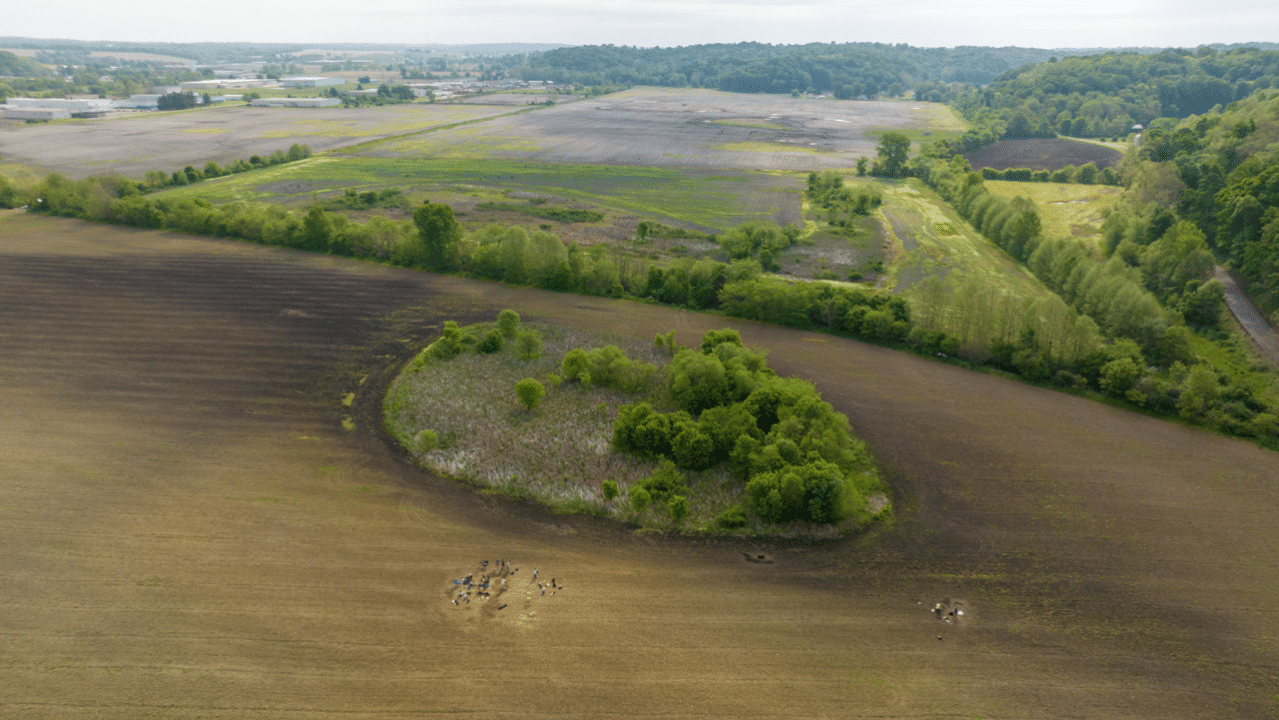
Athens, Ohio: A first-of-its-kind archaeology project has been funded at Ohio University by the Stream + Wetlands Foundation (S+W).
The project, funded for the next three field seasons by S+W, will conduct research across ancient hunter-gatherer sites near various wetlands areas across Ohio.
Dr. Joe Gingerich, an associate professor of Anthropology in Archaeology at Ohio University, is the lead researcher on this innovative project. Gingerich is highly respected in the field of Archaeology; he has held appointments as a Research Associate at the Smithsonian Institution National Museum of Natural History and is a past recipient of grants from National Geographic and National Science Foundation.
“We are extremely pleased and excited to move this project forward,” said Gingerich. “This collaborative research will help fill a gap in our knowledge of how early peoples used Ohio’s glacial lakes and wetland resources at the end of the last ice age.”
Over the next three years, the project will examine several Ohio locations near or within the portion of Ohio that was covered with glaciers during the last ice age. Researchers will conduct focused archaeological surveys and excavations and collect environmental cores for reconstructing past environments. The goal is to survey select wetlands with known evidence of the first hunter-gatherers in Ohio. The project will identify archaeological sites and then conduct limited excavations to understand how these areas were used by early people, based on the remains (artifacts) left behind. In addition to providing student experience in the field, the goal is to provide a publication of the findings to expand our knowledge of ancient wetlands.
This research will be a collaboration between Ohio University, the Stream and Wetlands Foundation, and the Ohio Department of Natural Resources (ODNR) Division of Mineral Resource Management, federal recognized tribes, private landowners and other State and Federal entities. To date, no known systematic surveys of Paleoindian sites in wetland environments have been conducted in this region. “This project has direct alignment with our goals,” said Chelsea Lamb Keefer, Strategic Partnerships Lead at the Stream and Wetlands Foundation. “Our efforts to restore, enhance and protect wetland habitats also include adding to the knowledge of why they are important. This funding does exactly that.”
About the Stream and Wetlands Foundation: the Stream + Wetlands Foundation (S+W) is a non-profit corporation based in Lancaster, Ohio, that was established in 1992. S+W restores, enhances, and protects aquatic resources to fulfill grants and to offset impacts to wetlands and streams that have been authorized through various state and federal regulatory programs. S+W is dedicated to the study and research of aquatic habitats to better understand these complex systems and strives to continuously improve its approach to restoring high-quality aquatic habitats and adjacent uplands. S+W has a long history of collaboration with OHIO on wetland and stream restoration and environmental research, especially through previous grants to Voinovich School of Leadership and Public Service at Ohio University.
About Ohio University’s Department of Sociology and Anthropology Program: Housed in OHIO’s College of Arts and Sciences, the Sociology & Anthropology Department builds from the strengths of faculty in the disciplines of anthropology and sociology. Both sociology and anthropology study human behavior, social interaction, and social organization. Both are concerned with how societies are organized and why people act as they do. Faculty conduct scholarly research in multiple areas, including social inequality, criminology, social theory, sociocultural anthropology, archaeological anthropology, and biological anthropology.
Contact:
Joseph A.M. Gingerich, Ph.D., Associate Professor of Anthropology in Archaeology
Department of Sociology and Anthropology, Ohio University
Athens, Ohio: A first-of-its-kind archaeology project has been funded at Ohio University by the Stream + Wetlands Foundation (S+W).
The project, funded for the next three field seasons by S+W, will conduct research across ancient hunter-gatherer sites near various wetlands areas across Ohio.
Dr. Joe Gingerich, an associate professor of Anthropology in Archaeology at Ohio University, is the lead researcher on this innovative project. Gingerich is highly respected in the field of Archaeology; he has held appointments as a Research Associate at the Smithsonian Institution National Museum of Natural History and is a past recipient of grants from National Geographic and National Science Foundation.
“We are extremely pleased and excited to move this project forward,” said Gingerich. “This collaborative research will help fill a gap in our knowledge of how early peoples used Ohio’s glacial lakes and wetland resources at the end of the last ice age.”
Over the next three years, the project will examine several Ohio locations near or within the portion of Ohio that was covered with glaciers during the last ice age. Researchers will conduct focused archaeological surveys and excavations and collect environmental cores for reconstructing past environments. The goal is to survey select wetlands with known evidence of the first hunter-gatherers in Ohio. The project will identify archaeological sites and then conduct limited excavations to understand how these areas were used by early people, based on the remains (artifacts) left behind. In addition to providing student experience in the field, the goal is to provide a publication of the findings to expand our knowledge of ancient wetlands.
This research will be a collaboration between Ohio University, the Stream and Wetlands Foundation, and the Ohio Department of Natural Resources (ODNR) Division of Mineral Resource Management, federal recognized tribes, private landowners and other State and Federal entities. To date, no known systematic surveys of Paleoindian sites in wetland environments have been conducted in this region. “This project has direct alignment with our goals,” said Chelsea Lamb Keefer, Strategic Partnerships Lead at the Stream and Wetlands Foundation. “Our efforts to restore, enhance and protect wetland habitats also include adding to the knowledge of why they are important. This funding does exactly that.”
About the Stream and Wetlands Foundation: the Stream + Wetlands Foundation (S+W) is a non-profit corporation based in Lancaster, Ohio, that was established in 1992. S+W restores, enhances, and protects aquatic resources to fulfill grants and to offset impacts to wetlands and streams that have been authorized through various state and federal regulatory programs. S+W is dedicated to the study and research of aquatic habitats to better understand these complex systems and strives to continuously improve its approach to restoring high-quality aquatic habitats and adjacent uplands. S+W has a long history of collaboration with OHIO on wetland and stream restoration and environmental research, especially through previous grants to Voinovich School of Leadership and Public Service at Ohio University.
About Ohio University’s Department of Sociology and Anthropology Program: Housed in OHIO’s College of Arts and Sciences, the Sociology & Anthropology Department builds from the strengths of faculty in the disciplines of anthropology and sociology. Both sociology and anthropology study human behavior, social interaction, and social organization. Both are concerned with how societies are organized and why people act as they do. Faculty conduct scholarly research in multiple areas, including social inequality, criminology, social theory, sociocultural anthropology, archaeological anthropology, and biological anthropology.
Contact:
Joseph A.M. Gingerich, Ph.D., Associate Professor of Anthropology in Archaeology
Department of Sociology and Anthropology, Ohio University